Author: admin

  • 12 Features of ELSS funds

    12 Features of ELSS funds

    Equity Linked Savings Scheme is a type of equity mutual funds that offers tax saving and wealth creation. Here are a few unique characteristics of ELSS that make it an ideal investment option.

    1. What is Equity Linked Savings Scheme Funds?

    Equity Linked Savings Scheme Funds (ELSS) also known as tax saving funds is an equity mutual fund that invests predominantly in equity stocks. ELSS funds offer tax exemption on a maximum investment amount of up to Rs. 1.50 lakh from your annual taxable income under Section 80C of the Income Tax Act, 1961. 

    2. Where do ELSS funds invest?

    ELSS funds invest in equity instruments such as stocks of listed companies. These funds allocate its investments across large, medium and small-sized companies. 

    3. Get the power of equities

    Historically, equity investments have outperformed other asset classes in the long-term. Investment in equity funds have the potential to help you fulfil your long term financial goals.       

    4. Avail the dual advantage of wealth creation and save on tax

    With ELSS, you can avail the dual advantage of wealth creation and save on taxes. As ELSS funds invest in equities, it has the potential to earn higher returns in the long term. Moreover, your returns from ELSS are deductible from the total income under Section 80C of the Income Tax Act, 1961. Hence, you get tax benefits with attractive returns through your investment in ELSS.

    5. No limit on investment

    There is no maximum investment limit on ELSS. You can earn market-linked returns on the entire investment amount. However, tax benefits on the investment are available up to Rs. 1.5 lakhs. 

    6. Achieve your financial goals

    As ELSS funds invest in equities with no cap on investment, it can help you achieve your long term financial goals such buying a house, planning for higher education and preparing for retirement.

    7. Invest through SIP or onetime lump sum investment 

    Lump sum and Systematic Investment Plan (SIP) are two popular ways to invest in ELSS funds. You can opt for a mix of both these investment options to gain the maximum advantage of investing in ELSS. In the SIP mode of investment, you need to invest a small amount of money over a period. Whereas, in case of lump sum investment, you invest in one go. 

    8. Systematic Investment Plan (SIP) Facility

    If you want to invest in ELSS through SIP, you don’t have to invest a large sum at one time or wait for the last moment. It is because you can plan your tax saving investment at the start of the financial year and invest in ELSS funds through SIP over the financial year. Although monthly SIP is a popular SIP frequency for salaried individuals, investors can opt for weekly, quarterly and half-yearly SIP frequencies as well. 

    9. Low minimum investment amount

    Investment in ELSS is affordable, as the minimum investment amount in ELSS fund through SIP is Rs.500. So, you do not worry about amassing a large corpus for investment. The low minimum amount makes it easy for different investors to invest in ELSS with no issue. 

    10. Lowest lock-in period

    The tax saving funds have the lowest lock-in period of 3 years. You can redeem your investments after three years without paying any penalty or exit load or continue to stay invested after the end of lock-in period. 

    11. No mandatory exit period

    There is no mandatory exit period of ELSS. You need not redeem your investments after the lock-in period of 3 years is over. You can stay invested in ELSS beyond this lock-in period until you are ready to redeem your investments. 

    12. Tax on capital gains

    Long Term Capital Gains on equity funds applies on ELSS funds as it has a lock-in period of three years. The capital gains from ELSS funds below Rs.1 lakh in a financial year is tax-free. The long-term capital gains above Rs.1 lakh in a financial year is taxed at the rate of 10%. 

    Make a smart financial move by investing in ELSS. 

    This blog is purely for educational purpose and not to be treated as an personal advice. Mutual fund investments are subject to market risks, Read all scheme related documents carefully.


  • Recency Bias

    Recency Bias

    Everything You Need To Know About Recency Bias

    We have all tried to butter up our parents; days before asking for permission to go out to party, haven’t we? Hoping that based on your recent behavior, they’d grant you the permission? Even our parents tend to grant us permissions based on our latest behavior. It is natural for people to focus more on the recent trends and information while forming an opinion and completely ignore the past information since it is so fresh in the mind.

    What is Recency Bias?

    Recency bias is the tendency of a person to be more biased towards recent events while making a decision and totally ignore the past events related to it. People are incredibly likely to focus on the most recent information about a situation, person or company, rather than remembering and focusing on the past information. Recency bias is a cognitive bias that acts a roadblock to rational thinking.

    For example, when the employee’s performance evaluation is round the corner, the employee portrays himself as a very diligent worker and shows himself as a model employee for his employer’s benefit. He will also try to flatter the employer and create a rapport with him in order to please him. During the time of the evaluation, the employer will favour the said employee as well, as the recent events are fresh in his memory. The employer won’t judge him based on his performance over the year and only focus on the recent encounters. Here, a well-deserving candidate who worked hard throughout the year might fail to get the appraisal, and the less deserving one might get a handsome appraisal.

    Recency Bias and Finance

    Recency bias is a concept in behavioral finance, which says that the investors are prone to give more importance to the short-term performance of a company rather than concentrating on the long-term performance. In case of an investment, recency bias is the biggest plague that could cloud an investor’s mind. Recency bias clouds one’s judgment and is harmful to our financial interests in the longer run.

    For example, an investor gets a profit of Rs 50,000 on his investment of Rs 1,00,000 in the first three months of the investment. In the last three months, the value of his investment falls to Rs 90,000. Here, the investor may deem this investment as a failure based on the most recent loss of Rs 10,000 rather than focusing on the overall profit of Rs 40,000 that he made. This is a case of recency bias.

    How to Overcome Recency Bias?

    Recency bias, although small, can prove to be of huge impact on one’s investment decisions. These biases can have an adverse effect on one’s investment. Here are some ways to overcome recency bias:

    1. Make a proper plan according to your financial goals: First, step is to understand what you want out of the investments and then invest. You need to create a financial plan that meets your short-term, medium-term, and long-term goals. You need to stick to these investments accordingly and not get swayed by the recent events in the market.
    2. Don’t get swayed by the recent changes in the market: As an investor, you need to make sure that you keep a neutral approach and shouldn’t get affected by the current numbers. It is silly to base all your expectations on one high number.
    3. Consult professionals: In case of doubts about an investment during a very volatile market, it is advisable to consult a financial expert. He or she will guide you as to how you should proceed and what direction you should go in.
    4. Maintain a vast portfolio: It is not advisable to put all your savings and hopes in one company. It is smarter to have a good portfolio so that one investment can mitigate the losses of another investment.

    Recency bias is the devil’s spawn in an investor’s life. It is important not to get swayed by the most recent numbers and changes in the market and maintain a neutral mindset while investing in any company. Current events can create an illusion in the investor’s mind; it is crucial to weigh in and look at all the aspects of an investment and not succumb to this bias.

    This blog is purely for educational purpose and not to be treated as an personal advice. Mutual fund investments are subject to market risks, Read all scheme related documents carefully.

  • Confirmation Bias

    Confirmation Bias

    Everything You Need To Know About Confirmation Bias

    Have you formed a wrong opinion of someone in your head? In a way that no matter how much good they ever do, you’d keep them at arm’s length, and nothing they do or say would budge your opinion of them?

    Humans have a tendency to ignore the facts that challenge their beliefs. They only choose to pay heed to the information that confirms their beliefs.

    Philosophers note the fact that humans have a hard time processing information in a rational manner once they have formed an opinion on a matter.

    What is Confirmation Bias?

    Confirmation bias is the likelihood of an individual or a group of people to process information by looking at only a part of the information, which concurs with their own existing beliefs. People are highly likely to process information to reinforce their own beliefs when the situation is highly relevant to them. Confirmation bias is when a person chooses to see only one side of a situation.

    For example, Rahul’s mother believes that wearing his red pair of socks during exams proves to be lucky for Rahul. In which case, if he wears the red pair of socks and he scores well in the exams, she will choose to believe that his red pair of socks led to him scoring well. She won’t see beyond her superstition to think of the fact that he might have scored well because of his hard work. Here, she chose to confirm that her superstition was right and will choose to ignore all the other facts. 

    Confirmation Bias and Finance

    In the world of finance, there is a concept of confirmation bias, which comes under behavioural finance. In more instances than not, investors tend to look for information that will support their view and belief on the investment and overlook the information that contradicts their investment idea. This leads the investors to make poor judgments in terms of their preference of investments and the buy and sell timing of those investments.

    For example, an investor hears a rumour about a company’s share price escalating from a source that they believe is reliable. He researches about the company in a way that confirms the rumours that he heard. Based on these rumours and research, he decides to bulk buy the shares of the said company without consulting his broker. In this scenario, the investor’s opinion is biased, and he might just end up buying shares of a redundant company, which may lead to him incurring a substantial loss.

    How to Overcome Confirmation Bias?

    Confirmation bias can prove to be very harmful as it affects the individual’s or group’s decision-making skills.Most people have an inherent confirmation bias, which they need to work on, or they might end up taking a wrong investment decision and make a potential loss.

    Here are a few ways to overcome confirmation bias:

    Maintain a skeptical perspective:The first step that one needs to take in order to overcome confirmation bias is to acknowledge that it exists. An investor, once he has gathered evidence that supports his claims, needs to challenge those views. It is important to reassess these views and make a list of the pros and cons of the investment. It is essential to question and try to prove yourself wrong in order to gain an unbiased opinion. It is vital to be skeptical and maintain a view that the said information is faulty and seek out information from a lot of sources. It is more important to focus on statistics than just circulated information.

    Avoid asking questions that confirm their views: Investors need to maintain a neutral view while asking questions about the investment. They shouldn’t ask probing questions that will lead to the confirmation of their own perspective. It would be a lot better if the investor asks generic questions to the broker who will help him decide whether the investment is good or bad with an unbiased conclusion.

    Circle back: After acquiring unbiased information about the investment from the broker, it is important to circle back and weigh in all the points and make an informed decision about whether or not to take the investment decision.

    It is essential to avoid being susceptible to confirmation bias and start questioning your perspective and research methods. Confirmation bias can be reduced by thinking of alternative scenarios and their consequences.

    This blog is purely for educational purpose and not to be treated as an personal advice. Mutual fund investments are subject to market risks, Read all scheme related documents carefully.

  • Don’t Be a Tourist in Your Own Investments

    Don’t Be a Tourist in Your Own Investments

    Don’t Be a Tourist in Your Own Investments

    Many people love to travel, but imagine visiting a country without knowing where you are, why you’re there, or how long you plan to stay. You follow crowds, take photos, and move from one place to another without understanding the culture, the routes, or the purpose of the trip. It may feel exciting for a while — but it rarely feels fulfilling.

    Interestingly, this is how many people approach investing.

    They participate but don’t fully engage. They invest, but don’t always understand. They become tourists in their own financial journey — present, but not truly involved.

    The Pull of Forecasts

    Every year, the financial world turns into a stage of predictions:

    • Where markets might go
    • Which sector could shine
    • When a correction may appear
    • When a rally might return

    Investors gather around these forecasts like people around a bonfire — for warmth, for hope, and for the comforting illusion that someone, somewhere, knows what’s going to happen.

    But here’s the uncomfortable truth:
    Markets don’t read forecasts.
    They rise when many expect them to fall.
    They ignore headlines that feel important.
    They move to rhythms no prediction can fully capture.

    Forecasts may comfort humans.
    Markets follow their own conditions.

    The Forecast-Driven Investor

    When predictions dominate, many investors start chasing narratives:

    • An expert says a correction is coming → SIP paused.
    • A sector is called “hot” → Investments rushed in.
    • A fund is popular on social media → Money redirected.

    Without realizing it, decisions become reactions.
    These investors check returns often but rarely check alignment with goals.
    They stay busy — but don’t always move forward.
    It’s like rearranging furniture during an earthquake.

    Why Do Forecasts Feel Convincing?

    Because they’re delivered confidently:

    • Studio lights
    • Detailed charts
    • Strong language

    But confidence ≠ certainty.
    Even the best analysts can be wrong.

    Forecasts often turn uncertainty into storylines.
    They reduce market complexity into digestible expectations.
    This makes them emotionally appealing — but not always useful.

    What Actually Moves Wealth: Behavior, Not Predictions

    There are two types of investors:

    1. The Prediction Chaser

    • Listens closely to forecasts
    • Reacts to every change
    • Pauses, shifts, rethinks often

    2. The Plan Follower

    • Focuses on goals
    • Reviews, but doesn’t overreact
    • Keeps investing steadily

    The second group may not always know what’s coming.
    But they tend to stay the course — and that consistency often supports better outcomes over time.

    The Market Doesn’t Know You’re Waiting

    Many investors delay action, waiting for a prediction to come true.

    • “I’ll start my SIP after the correction.”
    • “I’ll invest more once rates stabilize.”
    • “I’m holding cash for the perfect moment.”

    And sometimes — that perfect moment doesn’t arrive.

    Meanwhile, compounding pauses.
    Opportunities pass.
    Decisions stay pending.

    The market doesn’t move based on how prepared you are.
    It moves according to global factors, sentiment, data, and uncertainty.

    Forecast-Free Investing: A Calmer Way Forward

    Mutual Funds — especially SIPs — offer an approach that doesn’t require predictions.

    They are built on the belief that you don’t need to time the market to build long-term wealth.
    You don’t need to forecast next month’s returns to benefit from long-term trends.

    What you need is:

    • Time
    • Consistency
    • Discipline

    Volatility will come and go.
    What stays — is the structure that a SIP brings.

    From Tourist to Participant

    Investors who treat their portfolios passively — like tourists — tend to:

    • Know the fund name, but not the purpose
    • Check returns, but not review time horizon
    • React to trends, but not review strategy

    Over time, this leads to confusion, emotional decisions, and missed opportunities.

    In contrast, engaged investors understand:

    • Why each investment exists
    • What role it plays in their goals
    • How long they’re willing to stay invested

    This doesn’t require deep technical knowledge.
    Just clarity, purpose, and a willingness to stay involved.

    Ownership Changes Behavior

    Engaged investors:

    • React less to headlines
    • Anchor less on opinions
    • Feel more comfortable during market volatility

    They ask:

    • “What are my goals?”
    • “Does this fund align with my timeline?”
    • “Am I overreacting to a short-term event?”

    The result?
    A calmer, more intentional journey — driven by planning, not predictions.

    The Best Investors Don’t Predict — They Prepare

    They don’t ask:
    “What will markets do next?”

    They ask:
    “What should I do next, regardless of what markets do?”

    They stay prepared for corrections — not paralyzed by them.
    They continue SIPs — even when the news feels uncertain.
    They focus on goals — not temporary excitement.

    Because markets don’t reward perfect predictions.
    They tend to reward participation and discipline over time.

    Final Thought: Invest by Horizons, Not Headlines

    Forecasts will always exist.
    They’ll sound convincing.
    They’ll offer clarity, excitement, even hope.

    But if your investing is built only on forecasts — it may feel reactive.
    If it’s built on your goals — it can become resilient.

    Don’t be a tourist in your own investments.
    Be a participant with a map, a purpose, and the patience to stay the course.

    Because forecasts tell stories about the next 12 months.
    Your goals tell stories about the next 12 years.
    And that’s the story worth focusing on.

    This content is for investor education only. I/we act as an AMFI-registered Mutual Fund Distributor and do not provide investment advice. This blog should not be treated as investment advice or a recommendation. Mutual Fund investments are subject to market risks. Read all scheme-related documents carefully.

  • Why Gen Z Might Become the Most Emotionally Intelligent Investors Yet

    Why Gen Z Might Become the Most Emotionally Intelligent Investors Yet

    Why Gen Z Might Become the Most Emotionally Intelligent Investors Yet

    Every generation brings a new relationship with money. Some inherit caution, some chase opportunity, some react to scarcity, and some rebel against tradition. Gen Z is different in a quieter but more powerful way. They are growing up in a world that talks openly about emotions, burnout, boundaries, and mental health—and that may fundamentally change how they invest.

    For earlier generations, investing was often framed as a test of toughness. You were expected to ignore fear, suppress doubt, and stay “strong” when markets moved. Emotions were seen as weaknesses to overcome. The result? Many investors learned to hide their anxiety rather than manage it, leading to impulsive decisions during stress and overconfidence during good times.

    Gen Z doesn’t approach emotions the same way. They don’t believe feelings are something to suppress. They believe emotions are signals to understand. This shift matters more for investing than it appears at first glance.

    Markets don’t punish lack of intelligence as much as they punish emotional reactions. Panic selling, chasing trends, overconfidence, and constant switching are rarely caused by a lack of information. They’re caused by unmanaged emotions. A generation that is more comfortable acknowledging fear, stress, and uncertainty may be better equipped to address market behaviour.

    Gen Z has grown up watching volatility as the norm rather than the exception. Global crises, rapid technological change, social shifts, and economic uncertainty are not interruptions to their worldview—they are the backdrop. As a result, uncertainty feels familiar rather than threatening. This familiarity can translate into patience when investing, provided the system supports it.

    Another defining trait of Gen Z is their openness to automation. Unlike earlier generations who equated control with constant involvement, Gen Z is comfortable delegating repetitive tasks to systems. They use automation to reduce mental load, not increase it. This mindset aligns naturally with long-term investing.

    Automation removes daily emotional friction. You don’t need to decide whether to invest every month. You don’t need to react to headlines. The decision is made once, calmly, and executed repeatedly. For a generation that values mental clarity, this is not laziness—it’s intentional design.

    Gen Z also questions hustle culture more openly. While ambitious, they are increasingly aware of burnout and its long-term cost. They are less impressed by constant intensity and more interested in sustainability. This makes them more receptive to investment approaches that reward consistency rather than aggression.

    Mutual funds fit well into this emotional framework. They are not about predicting markets or pursuing short-term gains. They are about participation, patience, and structure. They allow investors to stay invested without needing to constantly engage emotionally.

    Some traits that may make Gen Z emotionally stronger investors include:

    • Comfort with acknowledging uncertainty and stress
       
    • Willingness to use automation instead of willpower
       
    • Preference for long-term systems over short-term excitement

    These traits reduce behaviour-driven mistakes, which are often the biggest threat to returns.

    Another reason Gen Z may excel emotionally is their resistance to traditional financial posturing. They are less likely to equate investing skill with bravado. Instead of pretending confidence, they are more willing to ask questions, admit confusion, and seek simple solutions. This humility is a hidden advantage.

    Earlier generations often entered markets through individual stocks, tips, or peer influence, equating activity with intelligence. Gen Z is more comfortable starting with broad, structured approaches. They don’t see simplicity as weakness. They see it as efficiency.

    There is also a strong alignment between Gen Z’s values and long-term investing. They think in terms of impact, sustainability, and future consequences. While these ideas often show up in social choices, they also influence financial behaviour. Long-term investing requires believing that the future is worth planning for—and Gen Z does.

    They are also more aware of mental energy as a limited resource. Constantly monitoring markets, reacting to volatility, and second-guessing decisions is draining. Gen Z prefers systems that work quietly in the background, freeing attention for life, work, and personal growth.

    Mutual funds, especially through systematic investing, offer that quiet progress. They don’t demand emotional engagement every day. They don’t require bravado during bull markets or emotional numbness during corrections. They simply keep going.

    When investing aligns with emotional intelligence, a few shifts tend to happen:

    • Volatility feels manageable rather than personal
       
    • Consistency becomes easier than intensity
       
    • Long-term thinking replaces short-term reaction

    This doesn’t eliminate mistakes, but it reduces their frequency and impact.

    Of course, Gen Z is not immune to challenges. Social media noise, comparison culture, and rapid information cycles can amplify anxiety. But awareness is the first line of defence. A generation that recognises emotional triggers is better positioned to design systems that neutralise them.

    That’s where mutual funds play a deeper role than just returns. They act as emotional buffers. They limit decision points. They create distance between feelings and actions. For emotionally aware investors, this is not a constraint—it’s protection.

    It’s also worth noting that emotional intelligence doesn’t mean avoiding risk. It means understanding it. Gen Z is not necessarily more conservative; they are more intentional. They are more likely to ask, “Can I live with this outcome?” rather than “How fast can this grow?”

    That question alone changes investing behaviour dramatically.

    The future of investing will likely reward those who manage emotions better than those who chase information faster. In that sense, Gen Z is entering the market with a quiet advantage. They are not trying to outsmart the market emotionally. They are trying to coexist with it.

    Mutual funds fit naturally into this coexistence. They allow Gen Z to participate in growth without turning investing into a source of stress or identity pressure. They support long-term thinking without demanding emotional suppression.

    Every generation invests in the tools and mindset of its time. Gen Z values mental health, balance, and sustainability. Those values may finally align with what investing has always required—but rarely encouraged—emotional intelligence.

    If that alignment holds, Gen Z may not just be savvy investors.

    They may be the calmest ones yet.

    This content is for investor education only. This blog should not be treated as investment advice or a recommendation. Mutual Fund investments are subject to market risks. Read all scheme-related documents carefully

  • SIP Is the Only Place Where Laziness Pays Off

    SIP Is the Only Place Where Laziness Pays Off

    SIP Is the Only Place Where Laziness Pays Off

    Laziness is usually seen as a weakness. We are taught that success demands constant effort, active decisions, and continuous monitoring. In most areas of life, doing less rarely produces better results. But investing through a Systematic Investment Plan challenges this idea. Here, doing less — once the right structure is in place — can often be more effective than doing more.

    Many investors believe good investing requires frequent action. They track markets daily, react to news, try to time entries, and attempt to outsmart volatility. Ironically, this constant involvement often leads to stress, confusion, and emotionally driven decisions. SIPs work differently. Once set up with clear thought, they allow investors to step back, automate discipline, and give time the space it needs to work.

    The strength of SIPs lies in their ability to reduce decision-making during emotionally charged moments. Markets move every day, but SIPs continue quietly in the background. There is no need to decide when to invest, how much to pause, or whether today is the “right” time. This kind of structured inaction can help protect investors from behavioural mistakes.

    For beginners, especially, this is powerful. Many new investors struggle not because they lack knowledge, but because maintaining consistency is difficult. Life gets busy, priorities change, and investing slips down the list. SIPs address this by turning intention into automation. Once the setup is in place, the system continues even when motivation fluctuates.

    Calling this laziness may sound counterintuitive, but it is a productive form of inaction. Instead of constantly checking markets or chasing performance, SIP investors allow regular investing to continue without interference. Over time, this reduced interference can lead to more stable outcomes compared to frequent tinkering.

    Markets tend to reward patience more than precision. Trying to invest at the perfect moment requires predictions that are difficult even for professionals. SIPs sidestep this challenge. They assume markets will fluctuate and incorporate those fluctuations into the process rather than treating them as something to fear.

    Another advantage of SIPs is the reduction in mental load. When investments are automated, there is less temptation to pause during market declines or increase amounts impulsively during rallies. The same process continues across different market phases, helping create a smoother investing experience.

    This is why SIPs tend to support “lazy” behaviour in a positive way:

    • They reduce the need for frequent decisions
    • They help limit emotionally driven reactions
    • They encourage consistency without constant effort

    This form of disciplined inactivity can often be more effective than frequent active intervention.

    Many investors underestimate the damage overactivity can cause. Checking portfolios daily, reacting to every headline, or adjusting investments frequently creates friction. Each decision introduces the possibility of timing errors. SIPs help reduce this friction by limiting opportunities to act on impulse.

    Laziness in SIPs does not mean carelessness. The initial setup still matters. Choosing an appropriate amount, understanding the investment’s purpose, and aligning it with a long-term goal are important. But once these decisions are made, much of the benefit comes from staying out of the way.

    SIPs also align well with real life. Income is earned regularly, expenses occur monthly, and goals unfold over years. Investing in small, regular amounts fits naturally into this rhythm. There is no pressure to accumulate a large sum or wait for the “right” moment. Progress happens gradually, month after month.

    Another subtle benefit of SIPs is their influence on expectations. Investors shift away from seeking immediate results and focus on long-term accumulation. This shift can help reduce anxiety and support patience. When returns are not checked obsessively, compounding is given the time it needs to take effect.

    Over time, SIP investors who adopt a more hands-off approach may notice:

    • Less stress during volatile markets
    • Fewer impulsive changes to their investments
    • Greater comfort staying invested for the long term

    These outcomes are not accidental; they reflect the impact of allowing the system to function with minimal interference.

    SIPs also make investing more accessible. You don’t need to be an expert or stay constantly informed. You only need to remain committed to the process. This simplicity can reduce intimidation, especially for those who feel overwhelmed by financial complexity.

    In a world that celebrates hustle and constant optimisation, SIPs quietly reward restraint. They show that wealth creation does not always depend on speed, intelligence, or perfect timing. Sometimes, it simply involves setting the right process and allowing it to continue.

    It is important to recognise that SIPs do not eliminate market risk. Volatility will still exist, and returns are never guaranteed. What SIPs can offer is behavioural support. They help investors stay invested through cycles by reducing opportunities for emotionally driven mistakes.

    This is why SIPs are often described as boring — and that is exactly their strength. There is no thrill, no constant excitement, and no daily decision-making. But boredom in investing is often a sign of discipline at work.

    Ultimately, SIPs show that laziness, when structured correctly, can be productive. By automating constructive behaviour and reducing unnecessary decisions, SIPs allow investors to focus on their lives while their investments continue to grow steadily in the background.

    SIPs are perhaps one of the few approaches in which stepping back, doing less, and trusting the process can support long-term outcomes. And in a world full of noise and constant activity, that quiet consistency can be a meaningful advantage.

    This content is for investor education only. This blog should not be treated as investment advice or a recommendation. Mutual Fund investments are subject to market risks. Read all scheme-related documents carefully

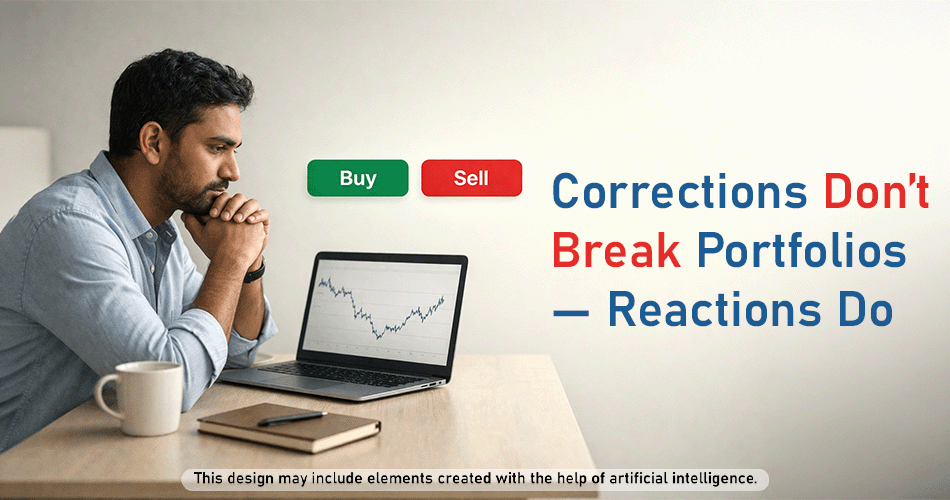
  • Corrections Don’t Break Portfolios, Reactions Do

    Corrections Don’t Break Portfolios, Reactions Do

    Corrections Don’t Break Portfolios — Reactions Do

    Every time markets fall, something familiar happens. Headlines get louder. Opinions multiply. Charts turn red. Conversations shift from optimism to concern almost overnight. Even investors who were calm just weeks ago begin to feel uneasy.

    Market corrections don’t just affect portfolios. They affect emotions.

    And that’s where the real damage often begins.

    A correction, by itself, is not unusual. Markets don’t move in straight lines. They expand, pause, adjust, and sometimes fall sharply before recovering. These movements are part of how markets function. They’re not interruptions to the system—they are the system.

    But while corrections are natural, reactions to them are not always rational.

    Most investors don’t lose wealth only because markets fall. They may lose potential long-term gains because of how they react when markets fall.

    It rarely looks dramatic in the moment. A pause in investing. A partial withdrawal. A decision to “wait and watch.” These actions feel reasonable. Even responsible. After all, no one wants to see their money decline.

    But over time, these small reactions create larger consequences.

    Investing is often described as a financial exercise, but in reality, it’s a behavioural one. The numbers matter, but behaviour determines how those numbers evolve. A well-constructed portfolio can withstand market corrections. But it cannot protect itself from repeated emotional decisions.

    This is the distinction many investors miss.

    A correction tests your portfolio.
    A reaction tests your discipline.

    And discipline is harder to rebuild than returns.

    One of the reasons reactions are so powerful is because they feel justified. When markets fall, fear feels logical. When markets rise, confidence feels deserved. But markets don’t always align with what feels right in the moment. Over time, they have tended to favour disciplined, long-term investing.

    Corrections are temporary. Reactions can be permanent.

    When investors exit during a fall, they don’t just avoid further decline—they also risk missing recovery. And recovery is unpredictable, and difficult to time. By the time confidence returns, prices have already moved.

    This is how long-term strategies get disrupted.

    Another layer to this behaviour is noise. During corrections, information increases dramatically. Every expert has an opinion. Every platform has an update. Every movement is analysed. This flood of information creates urgency—the feeling that you must do something.

    But activity is not the same as control.

    In fact, during volatile periods, doing less is often more effective than doing more. Not because inaction is easy, but because unnecessary action can create irreversible outcomes.

    Mutual funds are designed with this reality in mind. They don’t eliminate corrections, but they reduce the need to react to them. By spreading investments across assets and continuing through systematic processes, they aim to reduce the impact of market volatility.

    This doesn’t mean corrections feel comfortable. They rarely do.

    It means corrections don’t need to become decisions.

    Here’s where most investors unintentionally damage their portfolios:

    • They pause investments when markets fall
    • They exit positions out of fear, not strategy
    • They re-enter only after confidence returns

    Each of these actions feels reasonable individually. Together, they disrupt compounding.

    One of the hardest parts of investing is accepting that discomfort is part of the process. There is no version of long-term investing that avoids volatility completely. Trying to eliminate discomfort often leads to eliminating opportunity.

    This is why behaviour matters more than prediction.

    No one can control market movements. But investors can control their response to those movements. That control, though simple in theory, is difficult in practice. It requires clarity about goals, trust in structure, and the ability to tolerate short-term uncertainty.

    Most importantly, it requires reducing the number of decisions made under stress.

    This is where systems like SIPs become valuable. They don’t rely on confidence. They don’t wait for the “right time.” They continue through different market phases, removing the need to constantly evaluate whether to act.

    That consistency can help reduce emotional reactions.

    Another common mistake during corrections is comparison. Investors see others exiting, switching strategies, or making bold moves. This creates pressure to respond similarly. Standing still starts to feel like falling behind.

    But investing is not a race of reactions. It’s a test of endurance.

    The people who benefit most from markets are not those who react fastest. They are those who remain aligned longest.

    When investors shift focus from reacting to staying aligned, a few things change:

    • Market movements feel less personal
    • Decisions become less urgent and more deliberate
    • Long-term progress remains uninterrupted

    These shifts don’t eliminate volatility. They make it manageable.

    There’s also a deeper psychological insight here. Humans are wired to avoid loss more strongly than they seek gain. A small decline feels more painful than an equivalent gain feels rewarding. This bias makes corrections feel bigger than they are.

    Understanding this doesn’t remove the emotion—but it helps put it in perspective.

    Corrections are not signals that something is broken. They are reminders that markets are functioning. They clear excess, reset expectations, and create space for future growth. Without them, markets wouldn’t sustain themselves.

    The goal isn’t to welcome corrections. It’s to survive them without damaging your long-term path.

    This is where clarity matters.

    If you know why you’re invested, short-term movements don’t automatically trigger action. If your investments are aligned with long-term goals, temporary declines don’t feel like failures. They feel like phases.

    Mutual funds support this mindset by shifting focus away from individual movements toward overall direction. They reduce the need to respond to every change and allow investors to stay connected to their broader objectives.

    In the end, portfolios are rarely broken by markets alone. They’re weakened by repeated reactions—small, justified, emotional decisions that interrupt consistency.

    Corrections come and go.

    Reactions stay.

    And over time, it’s not the correction you remember. It’s the decision you made during it.

    So the next time markets fall, the question isn’t “What should the market do next?”
    It’s “What will I do differently this time?”

    Because that answer—not the market—can influence your long-term journey.

    This content is for investor education only. This blog should not be treated as investment advice or a recommendation. Mutual Fund investments are subject to market risks. Read all scheme-related documents carefully.