
Author: admin

  • 12 Features of ELSS funds

    12 Features of ELSS funds

    12 Features of ELSS funds

    Equity Linked Savings Scheme is a type of equity mutual funds that offers tax saving and wealth creation. Here are a few unique characteristics of ELSS that make it an ideal investment option.

    1. What is Equity Linked Savings Scheme Funds?

    Equity Linked Savings Scheme Funds (ELSS) also known as tax saving funds. It is an equity mutual fund that invests predominantly in equity stocks. ELSS funds offer tax exemption on a maximum investment amount of up to Rs. 1.50 lakh from your annual taxable income under Section 80C of the Income Tax Act, 1961.

    2. Where do ELSS funds invest?

    ELSS funds invest in equity instruments such as stocks of listed companies. These funds allocate its investments across large, medium and small-sized companies.

    3. Get the power of equities

    Historically, equity investments have outperformed other asset classes in the long-term. Investment in equity funds have the potential to help you fulfil your long term financial goals.

    4. Avail the dual advantage of wealth creation and save on tax

    With ELSS, you can avail the dual advantage of wealth creation and save on taxes. As ELSS funds invest in equities, it has the potential to earn higher returns in the long term. Moreover, your returns from ELSS are deductible from the total income under Section 80C of the Income Tax Act, 1961. Hence, you get tax benefits with attractive returns through your investment in ELSS.

    5. No limit on investment

    There is no maximum investment limit on ELSS. You can earn market-linked returns on the entire investment amount. However, tax benefits on the investment are available upto Rs. 1.5 lakhs.

    6. Achieve your financial goals

    As ELSS funds invest in equities with no cap on investment, it can help you achieve your long term financial goals such buying a house, planning for higher education and preparing for retirement.

    7. Invest through SIP or onetime lump sum investment

    Lump sum and Systematic Investment Plan (SIP) are two popular ways to invest in ELSS funds. You can opt for a mix of both these investment options to gain the maximum advantage of investing in ELSS. In the SIP mode of investment, you need to invest a small amount of money over a period. Whereas, in case of lumpsum investment, you invest in one go.

    8. Systematic Investment Plan (SIP) Facility

    If you want to invest in ELSS through SIP, you don’t have to invest a large sum at one time or wait for the last moment. It is because you can plan your tax saving investment at the start of the financial year and invest in ELSS funds through SIP over the financial year. Although monthly SIP is a popular SIP frequency for salaried individuals, investors can opt for weekly, quarterly and half-yearly SIP frequencies as well.

    9. Low minimum investment amount

    Investment in ELSS is affordable, as the minimum investment amount in ELSS fund through SIP is Rs.500. So, you do not worry about amassing a large corpus for investment. The low minimum amount makes it easy for different investors to invest in ELSS with no issue.

    10. Lowest lock-in period

    The tax saving funds have the lowest lock-in period of 3 years. You can redeem your investments after three years without paying any penalty or exit load or continue to stay invested after the end of lock-in period.

    11. No mandatory exit period

    There is no mandatory exit period of ELSS. You need not redeem your investments after the lock-in period of 3 years is over. You can stay invested in ELSS beyond this lock-in period until you are ready to redeem your investments.

    12. Tax on capital gains

    Long Term Capital Gains on equity funds applies on ELSS funds as it has a lock-in period of three years. The capital gains from ELSS funds below Rs.1 lakh in a financial year is tax-free. The long-term capital gains above Rs.1 lakh in a financial year is taxed at the rate of 10%.

    Make a smart financial move by investing in ELSS.

    This blog is purely for educational purposes and not to be treated as personal advice. Mutual fund investments are subject to market risks, read all scheme-related documents carefully.


  • Health insurance for senior citizens

    Health insurance for senior citizens

    How can Senior Citizens Get Health Insurance?

    For many people, life after 60 is like a second inning. They have paid their debt, educated their children, and made them capable of standing on their feet. So, senior citizens have enough time to pursue their hobbies or go on a world tour. Of course, one needs to be in good health to enjoy their retired life.

    However, senior citizens are the most vulnerable to diseases.Moreover, after retirement, sources of income may also dwindle. Hence, health insurance becomes the need of the hour. 

    In the past, it was almost next to impossible to get health insurance for senior citizens. However, things have changed after the Insurance Regulatory and Development Authority of India (IRDAI) set 65 years as the maximum age for entry into health insurance.

    This gave rise to health insurance plans for senior citizens. 

    What is health insurance for senior citizens?

    As the name suggests, health insurance for senior citizens is a health insurance plan that covers the health-related expenses of individuals above 60 years.

    The individual has to pay a health insurance premium at regular intervals to avail benefits of health insurance.

    Benefits of Senior Citizen Health Insurance

    Health insurance offers various benefits to senior citizens. Here are some of the essential benefits:

    Covers the cost of treatments: Medical treatments are getting costlier every year. Having adequate health insurance helps to stay protected from unexpected expenses from medical treatments. Most health insurance companies offer plans that cover various illnesses and other ailments. 

    Covers medical coverage to elderly individuals: Individuals above 60 years of age can get health insurance coverage through senior citizen health insurance as the regular health insurance plan offers coverage to individuals below 65 years of age.

    Maximum age to renew: One can not only take health insurance for senior citizens after 65 years, but policyholders can also renew the policy up to 80 years. Few companies also allow policy holders to renew their health plan until 90 years if there was no break in premium payment.

    Cashless hospitalisation: Most insurance companies that offer insurance plans for senior citizens allow cashless transactions. In cashless hospitalisation, the hospital settles the hospital bills with the insurance provider.

    Tax benefits: Payment of premium against the health insurance plancan be helpful to reduce taxable income as premiums paid are eligible for tax deductions under Section 80D.

    Things to know before buying senior citizen health insurance

    Before buying a senior citizen health insurance plan, here are some things that you need to know before buying a senior citizen health insurance plan.

    Lifetime renewability:

    As this health insurance plan aims at senior citizens, it should offer lifetime renewability. This will help senior citizens to renew their policies with no hassle. 

    Co-payment rate

    Most senior citizen health insurance plans have a co-payment clause. The co-payment clause is a clause that states that the insured individual has to pay a percentage of the total hospital bill.

    Typically, the co-payment rates can range from 20% to 50%.

    For instance, if the total hospital bill amount is Rs.5 lakhs and the co-payment rate is 30%. In this case, the health insurance company will pay Rs.3.5 lakh,while the policyholder needs to pay the remaining Rs.1.5 lakh.

    So, it is essential to buy a health insurance plan with a low co-payment rate.

    Entry and exit age

    Another essential factor that you need to consider is the entry and exit age. Select a health insurance plan that doesn’t have any entry or exit age. This will help you buy the health plan at any age and exit whenever you want to.

    Waiting period

    Typically, health plans come with a waiting period for existing illness. This is the length of time that you need to wait before utilising your plan’s full coverage.

    However, most senior citizen health insurance plans have a waiting period of up to 2 years for specific ailments. In addition, the waiting period can go up to 4 years for pre-existing diseases.

    Conclusion:

    Suppose you are a senior citizen and don’t have a health insurance plan. In that case, you can look at health insurance plans for senior citizens. It has various benefits. However, it is essential to compare a few factors such as lifetime renewability, entry and exit age, waiting period or co-payment rate before buying a senior citizen health insurance plan.

    This blog is purely for educational purposes and not to be treated as personal advice.

  • Financial lessons for your child

    Financial lessons for your child

    6 Simple Ways Parents Can Teach Money Lessons to Their Kids

    Did you know children learn money-saving habits by the age of seven? However, many parents are not comfortable or are very reluctant to talk about money with their kids. But it is a parent’s responsibility to teach money lessons and how to manage money to their kids

    If you are a parent, ignoring money lessons may not be the right thing to do for your child. We know it is difficult to teach these lessons to our children. Hence, we are sharing some ways that may make you feel comfortable while discussing money issues with your kids.  

    Help them distinguish between needs and wants

    It is common for kids to demand everything that they see on the shelves of a supermarket. But it won’t be wise to give everything to your kids even if you can afford it. Teach your kids the difference between ‘needs and wants’ with age-appropriate examples.

    For instance, if your child is begging you to buy drums and telling you how they really need them. You can tell them about the condition of a keyboard that they really needed a few months back.

    Let them earn their money

    Giving your kids the opportunity to earn their money may make them aware of the importance of money and hard work. You can give them a nominal amount of money when they complete the household chores. This will allow them to save money as they earn.

    Instill saving habit

    Helping your child inculcate a savings habit is an essential life skill. But asking your children to save money without explaining the reason behind it may be a very futile exercise.

    You can define a savings goal to keep your children motivated enough to save money.If your kids know what they want to save for, you can help them break down their target amount into smaller amounts and give them a certain amount of money every week or month to save towards their goal.

    Make them aware of the different saving options

    As your children save money, they will need a place to save that money. You can get piggy banks for your younger kids. Transparent piggy banks will give them a sense of accomplishment when they see their bank filling up with coins and notes. 

    Opening a bank account may be the best option for your older children. It will help them become familiar with banking and the different saving and investment options.

    Tracking their spending

    To be a better saver, one needs to be aware of where they are spending their money. Encourage your kids to track their spending and keep a note of it in a notebook or a money manager app.

    Give them interest on savings

    You may offer specific interest rates on your kid’s savings to make them excited about saving. If your kid is old enough, let them calculate the monthly interest they will earn on their current month’s savings. Paying a nominal monthly interest on their savings may help them save more.

    Conclusion

    Knowing how to manage money is an essential life skill. And as formal education ignores financial literacy, it is up to the parents to teach good money lessons to their kids.

    In this article, we have seen six ways parents can help their kids inculcate good financial habits.

    This blog is purely for educational purposes and not to be treated as personal advice. Mutual fund investments are subject to market risks, read all scheme-related documents carefully.

  • Bucket Strategy

    Bucket Strategy

    Bucket Retirement Planning vs Systematic Withdrawals for Retirement Planning

    Retirement planning is not just about when to take retirement benefits. It is also about how much to take. You can use many methods to create a stable income flow for retirement planning.

    If you’re planning for retirement, you’ve probably heard of bucket retirement planning. But what exactly is it? How does it differ from systematic withdrawals? What are the pros and cons of each approach? Let’s take a look!

    What is Bucket Retirement Planning?

    Bucket retirement planning involves using a set of funds to invest in several asset classes. These funds are dedicated to a specific portion of your portfolio, which is referred to as a ‘bucket’. This bucket is then used to make investments in different markets, including stocks, bonds, and cash.

    As a result, your investments are diversified into different asset classes. Your consumption will be from a single bucket, but you’ll have a variety of investment options to choose from. With bucket retirement planning, you have complete control over the amount of money you take out every year. This allows you to invest your funds in stocks and other risky assets if you choose to. However, you’re also able to keep a portion of your funds in safer investments, such as bonds, to ensure you won’t run out of money if the stock market dives.

    What is the Systematic Withdrawal method?

    A systematic withdrawal method takes money from your retirement fund. All of your assets are treated equally in this method, and you receive a monthly income from them. The systematic withdrawal technique can be used to liquidate or sell investments proportionally to fulfil income demands. This helps maintain a balanced asset allocation across mutual funds and other sub-accounts. According to a famous 1994 research by Bill P. Begen, a retiree should take four to five per cent of their savings annually.

    Points to Consider before choosing Bucket Retirement Planning or Systematic Withdrawal Method

    Differences in Psychology

    Systematic withdrawals are easier to manage and more predictable over time. However, investors struggle with this method during a market downturn or correction. They may grow concerned when the value of their retirement account decreases, leading to risk aversion and poor decision-making.

    Bucket retirement techniques are a great solution to address this issue. Because short-term investments are stored in cash or other liquid assets, a market collapse may only affect long-term “buckets” that retired individuals would be less worried about.

    Similarly, retirees may have invested the same amount, but giving different labels to accounts might encourage them to take on varying degrees of risk.

    These psychological advantages of bucket retirement planning may reduce panic-driven judgments.

    Similarities in Allocation

    Bucket and systematic withdrawal methods are comparable in terms of portfolio allocation and performance. Although one can use different bucket portfolio allocation techniques in other circumstances, the asset allocation mix of these strategies is similar. For example, person A may have 60% cash and short-term debt options in the first two buckets and 40% in equities in the last two buckets. In that case, it is a mix of 60/40 ratio between income and growth.

    Conclusion

    In principle, the bucket approach and systematic withdrawal method are comparable, since their asset allocations are pretty similar. However, there is a significant difference between these two techniques in practice because of investors’ cognitive biases. Investors are typically more comfortable with market drops and proper risk-taking when using a bucket approach than a standard systematic withdrawal strategy.

    You can talk to your financial advisor to know more. 

    This blog is purely for educational purposes and not to be treated as personal advice. Mutual fund investments are subject to market risks, read all scheme-related documents carefully.

  • Financial Minimalisation

    Financial Minimalisation

    Financial Minimalism and Financial Freedom

    Most of us strive to be financially independent. While financial freedom may look differe/nt for different individuals, we all want to have multiple options at our hands. And the dream to retire early or not work for money is a common goal for many individuals looking to be financially free.   

    One of the uses that can help you do that is financial minimalism.

    Financial minimalism is commonly considered a philosophy and way of living that can assist in achieving financial independence.

    By incorporating financial minimalism, you get the freedom of choice and the mental space to prioritise what is most important to you in life.

    Here are some of the ways to lead a life of a financial minimalist. 

    The Right Attitude

    The thing that always comes first when talking about money is the ‘right money mindset or the right attitude.’

    Having the right attitude or mindset is the number one step to make it easier to succeed in your quest for financial simplicity.

    It would help if you were motivated to achieve your objectives with an eye on the eventual goal of financial independence and potentially early retirement.

    We know that consumerism’s pre-existing concept causes us far more harm than good and is the primary driver of excessive spending.

    Spending less, breaking free from societal influences and reclaiming control of your finances is an empowering feeling. It can be challenging, but it is a highly gratifying process.

    Financial Awareness

    The second step is to be financially aware of your situation.

    Your capacity to handle your money is undoubtedly an important indicator when it comes to money management. Tracking your money and keeping track of your expenditures can help you determine if you’re overspending on your ‘wants’ or if your ‘needs’ are being met.

    Moreover, it is essential to keep tabs on the debt situation.   

    One of the fundamental concepts of financial minimalism is accepting responsibility for your own decisions and taking the proper steps to correct the situation.  

    Make a Budget & Follow it

    It is crucial to make a budget and give every rupee a place to lead a minimalist financial life. You can do that if you are aware of your financial situation.

    The first step is to recognise and differentiate between your needs and wants. Needs are expenses that we can’t postpone. For instance, rent, transportation costs, utility bills, insurance premiums and loan EMIs constitute needs. Anything else that you can quickly shift to the next month is a want.

    After you meet your needs, the next step should be to keep money aside for investing purposes. You can save the remaining amount for any emergencies. 

    Financial Sustenance

    Having financial freedom is one of the main reasons behind the adoption of financial minimalism. However, to take care of our livelihood needs, we need to arrange our finances so that our assets and investments can support our lifestyle even if we quit working.

    Living frugally and saving and investing a large portion of our earnings in asset classes that can generate income are some of the ways that can help us do that.

    This might be anything from rental properties to stock options that generate dividends. Investing in mutual funds consistently through the Systematic Investment Plan (SIP) can also help build a corpus and withdraw the required requirements regularly.

    Diversifying your investment portfolio can help you reduce your dependence on a single investment option.

    Conclusion:

    Many people around the globe have adopted minimalism as a way of life. It helps to bring clarity and focus to your life. Moreover, financial minimalism can also be a way to achieve financial independence.

    In this article, we have talked about four ways to guide your path to financial independence through financial minimalism.

    This blog is purely for educational purposes and not to be treated as personal advice. Mutual fund investments are subject to market risks, read all scheme-related documents carefully.

  • Why Should You Plan for Your Child’s Education?

    Why Should You Plan for Your Child’s Education?

    Saving and planning for your child’s education can be a daunting task for many parents. The level of responsibility and the amount of money that one has to save and invest requires a lot of wisdom and knowledge. This blog will look at the need to have a financial plan for your child’s education and some easy steps.

    If you think that there is enough time to plan for your children’s education, think again. The best and first step you need to follow if you want your child’s dreams to become a reality is to invest in their education ASAP.

    Don’t trust us? Let us look at the figures.

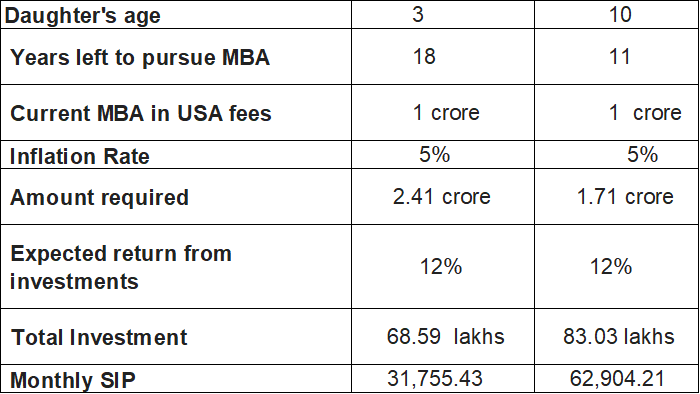
    Let us assume you would like it if your daughter does an MBA from a prestigious college in the US. She is too young to understand, but you want to be prepared.

    To help you understand the importance of early investing, let us consider two scenarios. In the first scenario, you invest when she is three years old, and on the other hand, you invest when she is ten years old. If we assume that she might want to pursue an MBA at the age of 21, then considering an inflation rate of 5%, you will need to accumulate Rs.2.41 crore and Rs. 1.71 crore respectively.

    However, you will require a monthly SIP of around Rs.31,000 when she is three and almost the double SIP amount if you invest when she is 10 years. This is the power of compounding. The sooner you invest, the better.

    Now that you understand the necessity of child education planning, let us go over some basics that will assist you in deciding about your child’s education.  

    Know how much time you have

    Calculate your child’s graduation year and post-graduate years. You can determine the time horizon by estimating the number of years.

    Figure out the total education cost

    The first step is to determine the overall cost of your child’s education. This depends on several things, such as whether your child wants to have a global education or prefers to study somewhere closer to home and the discipline that your child likes.

    Know where you financially stand

    To get a sense of where you are today and how to plan for the future, make a note of all of your assets and liabilities. This can assist you in making better plans. While preparing for your child’s education, keep in mind that you should avoid dipping into your investments for other financial goals, particularly your retirement fund.

    You should also avoid using funds set aside for your child’s education for non-educational purposes, such as house renovations.

    Decide how much you need to save/invest

    Once you know how much college will cost, you can plan accordingly. Decide how much you need to save right now or how much of a monthly contribution you’ll need to meet this goal by the required time.

    One simple way is to start a Systematic Investment Plan in a mutual fund and make regular contributions for your child’s education plans.

    To make a more significant contribution, you can eliminate unnecessary items from the budget or look for an additional source of income.

    Asset allocation and rebalancing

    Asset allocation is the breakup of the different assets, such as equities and debt in a portfolio. Proper asset allocation and investing are the smartest way to invest as per the time horizon and risk profile.

    You need to make sure that the asset allocation will help to achieve your child’s dreams.

    If your investment horizon exceeds five years, consider investing in equity funds, which have the potential to deliver higher long-term returns.

    Rebalance your investment portfolio gradually towards fixed income or debt as you get closer to your goal.

    A well-thought-out asset allocation boosts your portfolio’s returns. It can also operate as a shield, protecting your invested amount during times of market volatility.

    Conclusion:

    If you are a parent or plan to raise a child, you shouldn’t delay investing in their education. With the rising education costs and volatility in the job market, quality education has become imperative. So, start planning for your kid’s future today and make their dreams a reality.    

    This blog is purely for educational purposes and not to be treated as personal advice. Mutual fund investments are subject to market risks, read all scheme-related documents carefully.
  • Should You Invest in REITs?

    Should You Invest in REITs?

    Today’s investors have several investment options to fulfil their different goals: income generation or building wealth. And REITs is one such new investment avenue.

    From a global context, REITs are nothing new. But it is a relatively new investment option for Indian investors. While the REIT is still in its nascent stage in India, many industry leaders believe the sector will continue to grow.

     What is REIT?

    REITs are investment options that invest in real estate and infrastructure projects, respectively. It can also invest in the loans that back these real estate and infrastructure units.

    Simply put, REITs are like mutual funds. REITs invest in properties from the money pooled by investors like us instead of stocks and debt instruments.

    Structure of REIT

    Let us assume that company A built a commercial complex but wants to exit it. They may want to exit for various reasons.

    So, another company will form a REIT trust that will pool small amounts of money from individuals and institutions to invest in the complex. Investing can be done directly through a trust or Special Purpose Vehicles (SPV). An SPV is a company or limited liability partnership (LLP) in which a REIT owns or intends to own at least a 50% equity stake or interest. Besides holding and developing property and any incidental activity, an SPV is prohibited from engaging in any other activity.

    Criteria to qualify as a REIT

    Here are some criteria that a REIT needs to meet to qualify as REIT per SEBI guidelines 2019:

    The REIT needs to have an asset base of at least Rs.500 crore.   

    REIT should hold a minimum of 50% of the total nominal value of equity in that SPV.

    • It should distribute 90% of net distributable cash flow to investors as interest or dividend.
    • The REIT needs to invest 80% of the investment in income-generating assets, i.e., projects that are already completed.
    • REITs in India cannot invest in vacant land or agricultural land.

    Advantages of REIT over traditional real estate investment

    • REITs are an affordable real estate investment option. Traditional real estate investment options require a lot of money upfront.
    • Traditional real estate investment involves paperwork and making rounds of the government offices. In comparison, REITs make real estate investment as easy as investing in mutual funds or direct stocks.
    • Finding a suitable buyer and exiting a property may take months or even years. REITs have a lower liquidity risk, as you can redeem your units quickly and get the money credited to your bank account.  
    • The capital market regulator SEBI regulates REITs, and so there are minimal chances of fraud. 
    • REITs are also transparent as they have to disclose the capital portfolio on an annual and semi-annual basis.
    • REITs provide a higher dividend as it needs to distribute 90% of its income as dividends to investors.

    Conclusion

    REITs can be an alternative investment option for investors looking to diversify their investment portfolios. However, as it is a little more complicated investment option than mutual funds or any other investment option. Let us know if you want to know more about how to invest in REITs in India through mutual fund.

    This blog is purely for educational purposes and not to be treated as personal advice. Mutual fund investments are subject to market risks, read all scheme-related documents carefully.

  • SIP and present bias

    SIP and present bias

    How SIP takes care of Present Bias?

    You must have heard about the Systematic Investment Plan and the importance of setting up a SIP. But what is the reason behind Systematic Investment Plan or automating your savings and investments?

    This blog post will talk about how automation of investments can take care of Present Bias.

    What is automation?

    As the name suggests, automation is the process where you put things to run on auto-pilot. We can automate different parts of our lives, such as bill payments, paperwork and even investments. There are several benefits of automation, especially with investment.

    When we automate our investments, a part of our income gets automatically diverted to an investment account. It is much easier to save or invest an amount of our income through automation.

    But deciding on investing a sum of money every month isn’t easy for many people, especially for people who haven’t invested consistently.  

    What is SIP?

    A Systematic Investment Plan (SIP) is a way to automate mutual fund investments. After setting up a SIP, a pre-determined amount of money is debited to your mutual fund investment amount from your bank account.

    SIP is essential for many investors as it can help save or invest more money. But why does this take place?

    It is because SIP helps us to overcome Present bias. Present bias is our tendency to overvalue immediate rewards at the expense of long-term goals. It is the inclination to prefer a smaller present reward than a larger later reward. However, the preference is reversed when both rewards are equally delayed.

    Present Bias in Everyday Life

    Present bias is not just an investing behaviour. It shows up all the time. Some examples of present bias in everyday life are delaying preparing for a meeting until the last moments or ditching your plan to clean your wardrobe to binge-watch.

    So, we can see that binge-watching feels better than cleaning our wardrobe. This is even though we know that cleaning our wardrobe is important than binge-watching.

    How does Present Bias impacts investment decisions?

    Present bias may have devastating consequences when it comes to financial decisions. Overspending or expecting a future windfall might make it challenging to save now and hinder long-term investing performance.

    Take, for example, retirement. When you’re young, unmarried, and just starting in your job, saving for retirement may seem insignificant compared to enjoyable holidays or extravagant purchases. However, the strategy of “I’ll get to it later” might result in a higher hill to climb the longer you wait. That lack of long-term planning and saving might eventually have an enormous influence on your retirement preparation.

    If the money was in your account, you might be able to persuade yourself to spend it.

    How SIP removes present bias?

    You can’t spend money you don’t have. You can only spend money when it is in your account. Placing it out of sight serves as a reminder that it has been set aside for other use.

    Paying yourself first allows you to put the money you need for savings and expenses “out of sight, out of mind.” When confronted with an appealing purchase, this makes it much simpler to resist temptation.

    You might feel the pinch in the first few months. You may not be able to buy everything that you want. But slowly, it will become a part of your life, and you will design a fulfilling life around it. SIP is a simple yet powerful way to achieve your goals.

    Conclusion: Present bias is a common bias. Besides our day to day lives, present bias also influences our investment decisions. Because of the bias, we postpone our investments and focus on activities and things that make us feel good in the present situation. Automation is the best way to overcome present bias in our investment decisions. You can carry out automation in different investment options. If you invest in mutual funds, SIP is a facility that allows you to automate your investments and achieve your financial goals.  

    This blog is purely for educational purposes and not to be treated as personal advice. Mutual fund investments are subject to market risks, read all scheme-related documents carefully.

  • Why you shouldn’t depend only on EPF for your retirement?

    Why you shouldn’t depend only on EPF for your retirement?

    When most people think of retirement, they think of employer benefits like Employee Provident Fund (EPF). While this is a great option, but it is not the only one. You can supplement with other investment options such as mutual funds. This blog will highlight the importance of investing in mutual funds for your retirement.

    EPF is a tax-efficient investment instrument and has the backing of the government.

    Mutual funds and EPF can help boost your retirement savings and ensure that you don’t run out of your retirement savings.    

    Here are some reasons you shouldn’t rely entirely on your employer for your retirement benefits:

    EPF is primarily a debt-based product:  

    EPF is primarily a debt-based product. It is essential that you understand that EPFO can invest up to 15% of its incremental flow in equities. 

    Equity-based instruments have the potential to make real returns on your money. Real return is the return given by the investment option after subtracting the effect of inflation.

    You can build a retirement corpus if you invest in options that beat inflation, especially if you start early. You can invest in equity-oriented mutual funds, which involve higher risks than most other investment instruments but offer impressive returns over time.

    Minimal investment amount:

    In EPF, employees and employers both contribute 12% monthly to EPF. They can contribute up to 12% of Rs.15,000, or Rs.1800. However, if your income exceeds Rs.15,000, the company is not required to contribute 12%. So, regardless of your income, the employer’s contribution may be smaller.

    Basically, the overall amount that gets credited to your EPF account may not be sufficient to fund your retirement goals.

    You can invest more in your EPF account. This option is called Voluntary Pension Fund (VPF), and it is an extension of EPF.

    Previously, VPF investments were tax-free. However, according to Budget 2021, if your EPF and VPF contributions exceed Rs. 2.5 lakh in a financial year, they tax the interest that you earn on such contributions.

    Cap on maximum investment amount:

    As an employee, you can make tax-free contributions of up to 12% of your basic to EPF. If you want to invest more towards your retirement plan, you can invest in mutual funds. You may choose from a variety of mutual funds depending on your investment objectives and time horizon.

    If you invest in mutual funds, there is no cap on the maximum investment amount. Moreover, taxes apply on redemption.

    Availability of different investment options:

    Mutual funds offer different investment options such as lumpsum and Systematic Investment Plans. It means that you can make investments at any time of the day from anywhere.

    A systematic Investment Plan (SIP) is a regular investment plan through which you can invest a predetermined amount at regular intervals. You can also increase or decrease your SIP per your financial conditions. So, mutual funds offer investment flexibility that EPF does not provide.

    Conclusion:

    The importance of retirement preparation cannot be overstated. It’s possible that relying on EPF isn’t the greatest option. Inflation might deplete your savings faster than you expect, so your retirement fund may not be sufficient to pay your daily expenses. You might use a Systematic Investment Plan (SIP) to invest in mutual funds for retirement income. SIP allows you to invest a set amount at regular intervals. It’s completely optional, and you may increase, decrease, or stop your SIP investments at any time. As a result, you may develop a retirement plan and invest to meet your retirement objectives.

    This blog is purely for educational purposes and not to be treated as personal advice. Mutual fund investments are subject to market risks, read all scheme-related documents carefully.

  • Simple Steps to Never Run Out of Money

    Simple Steps to Never Run Out of Money

    Do you earn a handsome amount of money but have no clue where your money goes? Do you run out of money every month?

    This blog is about the best ways of staying in control of your finances and never run out of money. We will discuss how to stay in control of your debt, avoid frivolous spending, and optimize your income.

    1. Keep track of your income and spending

    Keeping track of your everyday spending may appear tedious, but it is the most effective approach to avoid unnecessary financial withdrawals. You will become more aware of how you spend your money after this exercise. You may find the flaws in your budget by looking at the cash withdrawals at the end of each month. Once you identify the flaws, the following step is to eliminate any unnecessary costs to free up resources that may be put to better use elsewhere.

    2. Make projections for future requirements

    Determine your sources of income and spending. Future financial obligations or needs, such as the amount of money that you will need to maintain a particular quality of living, the amount needed for retirement, and so on, can be predicted in advance. For correct calculations, you need to include inflation. When your financial situation changes because of shifting life objectives, you must account for these changes in your future forecasts.

    3. Make saving a top priority

    We all have seemingly limitless ambitions. Prioritizing helps you to discover and focus your efforts on the most essential goal at any given time. The first item on your priority list should be “saving.” Saving compels us not to get goods now so that we can have greater ones later. Once you receive your pay, you should set aside a portion of it for savings. Ideally, you should set aside 20% to 40% of your salary for savings. You can spend the rest of your money for other purposes.

    4. Investment is equally important

    Saving is a good habit. But it’s also vital to put your money into growth opportunities that will help you develop a healthy portfolio. As a general guideline, invest a percentage of your money equal to 100 minus your age in stocks. For example, if your age is X, invest (100-X) % of your funds in equities. Equity has traditionally delivered a CAGR of about 15-16% over 15-20 years, making it an appropriate investment instrument for medium to long-term goals. The easy way to invest in stocks is through mutual funds. You may get the benefits of diversification by going the mutual fund way.

    5. Put the power of compounding to good use

    Using Systematic Investment Plans, investors may make compounding work to their advantage. This also helps them to be more disciplined in their investment. After 30 years, a monthly investment of Rs 10,000 in a SIP in an equities mutual fund with a 12% annual return results in a corpus of Rs 3.2 crores. Even if one does not have much money, beginning a SIP early on can help one gain a lot of money over time.

    6. Save for a rainy day

    Any emergency has the potential to deplete your resources. In the event of such a calamity, having an emergency fund separate from your savings and investments can assist you in meeting unanticipated financial obligations. An emergency fund should keep you afloat for at least three months, even if there are no inflows. You may automatically save a specific amount from your salary towards an emergency fund. You can also invest in options such as short-term debt funds or liquid funds as an alternative.

    These were the six tips that can help you from running out of money. Consult us to know more and make sure that you never run out of money.

    This blog is purely for educational purposes and not to be treated as personal advice. Mutual fund investments are subject to market risks, read all scheme-related documents carefully.